Wednesday, December 12, 2018

New Theory Suggests Gold Deposits Formed as a Result of Earthquakes

New Theory Suggests Gold Deposits Formed as a Result of Earthquakes....

A new theory based on a simple but valuable geologic model claims that 80 percent of all commercial gold deposits were formed in a flash.


Gold seams are formed when mineral-rich water flows through networks of cracks in rocks at some 15-30 km deep. But the correct mechanism of deposition of gold is not the one as documented. According to this theory, local earthquakes pull rocks apart brutally, so fast that any fluid thy contain are vapourized,  leaving behind the minerals they were carrying.


Richard Henley of the Australian National University in Canberra and Dion weatherely of the University of Queensland in Brisbane have studied earthquake dynamics, and found that quake-triggered pressure changes are much larger than was previously believed; earthquake-triggered pressure are traditionally considered to be a part of the process, but their impact was considered to be quite small. According to Henley however, earthquakes can open cracks in the deep rocks at the speed of sound.

“Large quantities of gold may be deposited in only a few hundred thousand years,” says Weatherley – a brief interval by geological standards. “Each event drops a little more gold,” adds Henley. “You can see it microscopically, tiny layer after tiny layer. It just builds up.


link: shazab786.blogspot.com


Saturday, November 17, 2018

new Mineral harder than diamond_uakitite

                           Mysterious New Mineral Found In Meteorite


Russian scientists claimed that they have found a new type of mineral in a meteorite which is harder than diamond.

A meteorite discovered in Russia in 2016 has been analyzed and scientists performed different tests on the mineral, now they have claimed that it contains a mineral which is harder than diamonds.

the space rock was found by gold hunters in Siberia, and extensive tests have been performed on it.

Boris Shustov,  head of institute of astronomy of the Russian Academy of Sciences, said that it was fairly common to find a new mineral in meteorites because those minerals grow under different cosmic conditions.

scientists named this mineral Uakitite.


The new discovery was unveiled by researchers from the Ural Federal University, Novosibirsk state university and geological institute at the Siberian branch  of  the Russian Accademy of Sciences.

A statement from the university said: "It forms isometric crystals  or rounded grains. The size of grains of uakitite is less than 5 micrometers."

Participants at the Annual Meeting of Meteoritic Society in Moscow, were the first to hear about the discovery of new mineral which is as hard as diamond.

The study was published in https://metsoc2017-santafe.com/

Monday, October 1, 2018

Life on Moon

                                             Moon and Life on Moon


Sunday, September 16, 2018

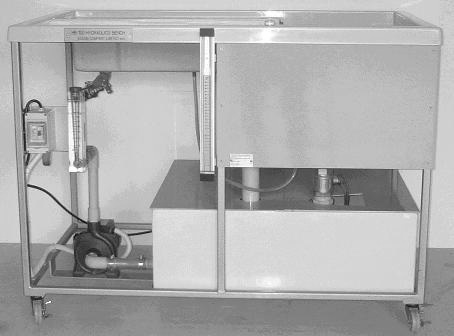
parts of hydraulic bench

Hydraulic bench:
Hydraulic bench is a very useful apparatus in hydraulics and fluid mechanics. It is involved in majority of experiments to be conducted e.g. To find the value of the co-efficient of velocity ‘Cv’, coefficient of discharge ‘Cd’, to study the characteristics of flow over notches, to find metacentric height, to find head losses through pipes, to verify Bernoulli’s theorem etc.

Parts of Hydraulic Bench Machine:

Its parts are given below:

Centrifugal pump:

It draws water from sump tank and supplies it for performing experiments.

Sump Tank:

It stores water for Hydraulic bench. It is located in the bottom portion of Hydraulic bench. Water from here is transported to other parts by using a pump. It has a capacity of 160 liters.

Vertical pipe:

It supplies water to the upper part of hydraulic bench from sump tank through a pump.

Control valve:

It is used to regulate the flow in the pipe i.e. to increase or decrease the inflow of water in the hydraulic bench.
Parts of Hydraulic Bench

Connector:

With the help of this we can attach accessories with the hydraulic bench. Special purpose terminations may be connected to the pump supply by unscrewing connector, no hand tools are required for doing so. It is located in the channel.

Channel:

It is used in number of experiments It provides passage for water for different experiments.

Drain valve:

It is used for emptying sump tank.

Side channels:

They are the upper sides of the channel. They are used to attach accessories on test.

Volumetric tank:

It stores water coming from channel. This tank is stepped to accommodate low or high flow rates. It has a capacity of 46 liters.

Stilling baffle:

It decreases the turbulence of water coming from channel. It is located in the volumetric tank.

Scale & Tapping:

A sight tube and scale is connected to a tapping in the base of the volumetric tank and gives an instantaneous indication of water level.

Dump valve:

It is at the base of the volumetric tank. Opening the dump valve allows the entrained water to return to the sump tank for recycling. It is used for emptying volumetric tank. It is located in the bottom of the volumetric tank.

Actuator:

Dump valve is operated by a remote actuator, lifting actuator opens the dump valve, when it is given a turn of 90’ it will turn the dump valve in the open position.

Over flow:

It is an opening in the upper portion of the volumetric tank. It sends the water level above 46 lits to the sump tank.
Measuring cylinder
A measuring cylinder is provided for measuring of very small flow rate. The cylinder is stored in the compartment housing the pump.

Starter:

It on / off the hydraulic bench.

Thursday, September 13, 2018

Fluid Mechanics

                                                       Fluid Mechanics


                INTRODUCTION TO FLUID MECHANICS

Mechanics: 
     It  is the oldest physical science that deals with both stationary and moving bodies under the influence of forces. A substance in the liquid or gas phase is referred to as a fluid. A fluid deforms continuously under the influence of shear stress, no matter how small.

Fluid Mechanics:
Fluid mechanics is defined as the science that deals with the behavior of fluids at rest or in motion. 

Branches of fluid mechanics:
There are three branches of fluid mechanics as follows:
1) Fluid statics
2) Fluid kinematics
3) Fluid dynamics

1) Fluid statics:
The study of fluids at rest. The study of fluids which are completely at rest.
2) Fluid kinematics:
The study of fluids in motion, where pressure forces are not considered.
3) Fluid dynamics:
If the pressure forces are also considered for the fluids in motion,that branch is called fluid dynamics.

                 Some Applications Of Fluid Mechanics:
  1. sea / river (flood) defences
  2. water distribution
  3. Hydraulic design of water
  4. Dams
  5. Irrigation
  6. Pumps and turbines
  7. water retaining structures


Monday, September 3, 2018

Engineering Mechanics

                                               Engineering Mechanics
       Engineering mechanics is the study of forces that act on bodies and the resultant motion that those bodies experience. Engineering mechanics subject involves the application of the principles of mechanics to solve real-time engineering problems.


<


Types:

  There are two types of engineering mechanics


1) statics
2) Dynamics


1. statics:

Statics is the branch of mechanics that deals with the study of objects at rest. Objects at rest may or may not be under the influence of forces.


2. Dynamics:

Dynamics is the branch of mechanics that deals with the study of objects in motion and the forces causing such motion.


Dynamics Types:

Dynamics can be further classified into two types. They are:
  1. Kinematics
  2. Kinetics

2.1 Kinematics:

Kinematics is the study of the motion of bodies without consideration of the cause of the motion. Kinematics deals with the space-time relationship of the motion of a body. Some examples of kinematic concepts are displacement, velocity and acceleration.
2.2 Kinetics:
Kinetics is the branch of mechanics which deals with the study of the motion of bodies by considering the cause of motion.